

Electrolyte Tablets vs Powder for Recovery: Which Works?
Table of Contents
- Electrolyte Tablets vs Powder for Recovery: The Core Trade-Off
- Dosing Accuracy: Why Scoops and Sachets Fall Short
- Hitting the Optimal Hydration Concentration Every Time
- Ease, Convenience and Travel: How to Stay Hydrated While Travelling
- Cost, Wastage and Tracking: What You Actually Use
- Who Each Format Suits: Training, Travel and Daily Use
- Conclusion: Choosing Your Recovery Format
- Frequently Asked Questions
Last Updated: October 3, 2026
Electrolyte Tablets vs Powder for Recovery: The Core Trade-Off
Electrolyte tablets vs powder for recovery comes down to one question: do you want precision and portability, or volume and lower cost per serving? At Vitaliva, our hydro boost are effervescent tablets, so treat our view as one side of that argument. But the trade-off is real, and it decides which format suits you.
A tablet is a fixed dose. Drop one into 500ml of water and you get the same concentration every time. Powder asks you to scoop, guess, and hope. Most people get it roughly right. Roughly is not a measurement.
The comparison below sets out where each format wins and loses.
Factor |
Tablets |
Powder |
|---|---|---|
Dose accuracy |
Fixed per tablet |
Depends on your scoop |
Travel |
Tube fits any bag, no security questions |
Loose powder invites inspection |
Concentration control |
98mmol/l in 500ml, repeatable |
Varies with scoop and water volume |
Moisture protection |
Desiccant in the cap |
Clumps once opened |
Wastage |
None, count what's left |
Spills and half-scoops |
Cost per serving |
Higher |
Lower |
The rest of this article explains why those differences matter in practice, and which format fits your training week.
Dosing Accuracy: Why Scoops and Sachets Fall Short
Scoops and sachets fail on accuracy for a simple reason: the scoop measures volume, not the electrolytes you actually need. A level scoop, a heaped scoop, and a scoop in a hurry are three different doses. Add a water bottle with no markings and the error compounds.
A common mistake is assuming the scoop in the tub is calibrated to your bottle. It is calibrated to nothing in particular. Many people use a 750ml bottle with a scoop meant for 500ml, which dilutes the mix. Others use less water than intended and get a drink that is too strong to finish or over concentrated in electrolytes that does not have the same desired effect.
Tablets remove that variable. One tablet, 500ml, done. The maths stays simple and repeatable.
Hitting the Optimal Hydration Concentration Every Time
Optimal hydration concentration is the electrolyte strength your body absorbs fastest, and it is the strongest argument for tablets. Add one Hydro Boost tablet to 500ml of water and you get a precise 98mmol/l concentration, every single time.

That precision is hard to match with powder. A scoop that is slightly over or under, combined with a bottle that holds slightly more or less than you think, shifts the concentration in both directions. You will not notice the difference on one drink. Over a training week, you will notice it in how you feel.
Why does concentration matter so much? Fluids move into your bloodstream fastest when the electrolyte balance sits close to your body's own. Too weak, and you are mostly drinking water. Too strong, and the drink sits heavily and slows absorption. Getting the ratio right is the whole point of an electrolyte product.
NHS guidance on dehydration and fluid intake sets out the signs to watch for, including headaches, dark urine and tiredness. Those symptoms are your signal that plain water alone is not cutting it.
Ease, Convenience and Travel: How to Stay Hydrated While Travelling
Knowing how to stay hydrated while travelling starts with what you can actually carry. Tablets travel. Powders do not, at least not without hassle. A tube of tablets goes in a carry-on, a gym bag or a desk drawer and raises no questions at security.
Loose powder is a different story. A bag of white powder in hand luggage is an invitation to a conversation nobody wants at an airport checkpoint. Even in a labelled tub, it gets pulled aside. Electrolyte powder gets the same treatment, because it looks identical on a scanner.
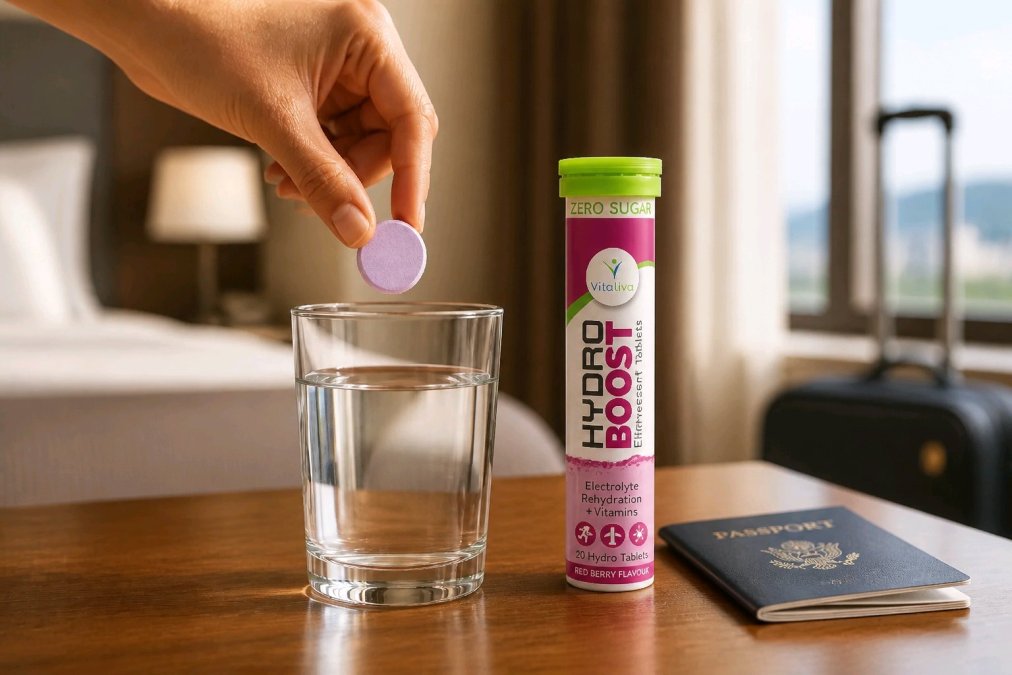
Tablets travel. Powders don’t.
There is a second travel problem powders cannot solve: moisture. Humidity and temperature changes turn powder into a solid block. Each tube has a desiccant within the cap to keep moisture out, which is why hydro boost survives a hot car or a damp hotel room. Powders have no equivalent protection once the tub is open.
Hydro Boost Blackcurrant Flavour →
Cost, Wastage and Tracking: What You Actually Use
Powder usually costs less per serving, and that is its main advantage. The catch is that you rarely use every gram you pay for. Spills, clumped powder, and the last awkward scoop at the bottom of the tub all eat into the value.
Tablets give you a clean count. A 20-tablet tube holds 20 servings, and when you shake it you know exactly how many are left. That makes planning a training week straightforward: five sessions, five tablets, plus a couple spare for hot days. No estimating, no waste.
Here is how we would plan a typical week:
- Count your sessions for the week ahead
- Add one tablet per session
- Add two extra for travel or hot weather
- Check the tube before your last session of the week
- Reorder when you hit five remaining
Who Each Format Suits: Training, Travel and Daily Use
Powder suits people who mix large volumes at home and value a lower cost per serving. If you train in one place, keep a tub on the kitchen counter and drink from the same bottle every day, powder works fine.
Tablets suit everyone else. Gym-goers who want a fixed dose after a session, travellers dealing with flight dehydration, and anyone following a keto, vegan or gluten-free diet who needs a formula they can trust. Hydro Boost is sugar-free, lactose-free, gluten-free and suitable for vegans and vegetarians, containing key electrolytes and vitamins.
British Nutrition Foundation guidance on hydration makes the point that needs vary with activity, climate and diet, so a fixed, repeatable dose is easier to adjust than a scoop.
The honest limitation: tablets cost more per serving than a large tub of powder. If you are mixing three litres a day at home, that gap adds up. For most people training a few times a week, the accuracy and convenience are worth it.
Conclusion: Choosing Your Recovery Format
Powder is cheaper. Tablets are more accurate, easier to carry and impossible to spill. If you want a fixed accurate concentration of electrolytes every time, with a desiccant cap keeping moisture out and a tube that tells you exactly how many servings remain, that is what we make.
Hydro Boost comes in Blackcurrant and Red Berry, both at £8.99 for a twin pack, with zero sugar and no artificial colours, flavours or preservatives. Add to cart and take the guesswork out of your next session. We hope our brief guide was useful.
Frequently Asked Questions
Are electrolyte tablets more effective than powders for recovery?
It depends on how precisely you dose them. Electrolyte tablets dissolve in a fixed volume, so each serving delivers a consistent electrolyte concentration. Powders rely on you measuring the right scoop into the right amount of water, and small errors change the concentration. For recovery, consistency matters because your body responds to the concentration of sodium, potassium, calcium and magnesium, not just the presence of them.
Why are electrolyte tablets better for travelling?
Tablets travel because they are compact, dry and sealed in a tube. Powders are loose and open to suspicion at security, which can slow you down. A tube of tablets fits in hand luggage without leaking or clumping, and you can drop one into any 500ml bottle of water once you are through. That makes them far easier to carry on a flight or a multi-day trip.
How do I ensure precise electrolyte dosing in my water?
Use a product with a fixed serving size. For example, adding one Hydro Boost tablet to 500ml of water gives a precise 98mmol/l concentration of electrolytes for optimal hydration. With powder, you are guessing at both the scoop and the water volume, so the concentration varies. A tablet removes both variables, and the tube cap contains a desiccant to keep moisture out, which powders cannot match.
Do electrolyte powders expire faster than tablets?
Powders are more exposed to air and moisture once opened, which can cause clumping and reduce shelf life. Tablets in a sealed tube with a desiccant in the cap stay dry and stable for longer. If you buy in bulk and use them slowly, tablets hold their condition better. Always check the best-before date on either format and store them away from heat and damp.
Choosing a recovery format should not be a gamble. Vitaliva makes Hydro Boost effervescent tablets with a fixed dose for 500ml of water, a desiccant cap to keep moisture out, and a formula that is zero-sugar, vegan and keto-friendly. Get started with Vitaliva and give your training week a hydration routine you can actually count on.